


Renault Exits F1, Ending a 50-Year Legacy of Innovation and Controversy
Summary
Renault's departure from F1 closes a nearly 50-year chapter marked by pioneering turbo engines, multiple championship titles as both a constructor and supplier, and the infamous Crashgate scandal.
Renault is officially departing from Formula 1, closing a nearly 50-year chapter defined by pioneering turbo technology, championship-winning dominance, and significant controversy. From its 'yellow teapot' debut to powering legends like Prost and Alonso, the French manufacturer's exit as a power unit supplier marks the end of a significant era for the sport, leaving the Alpine team to become a Mercedes customer.
Why it matters:
- Renault's exit removes a major manufacturer and engine builder from the grid, a significant loss for a sport priding itself on cutting-edge engineering and innovation.
- The brand's history is a microcosm of F1 itself, showcasing incredible highs (dominance with Williams and Alonso) and deep lows (early unreliability, Crashgate).
- Their final departure as a power unit supplier highlights the immense financial and technical barriers in the modern hybrid era, forcing even historic names to become customers.
The details:
- 1977 Debut: Renault entered F1 with the RS01, the sport's first turbocharged car, which was notoriously unreliable and nicknamed the 'yellow teapot' due to frequent smoke.
- First Victory: Jean-Pierre Jabouille secured Renault's first win at the 1979 French Grand Prix, a landmark moment for turbo technology that paved the way for future dominance.
- 90s Supremacy: As an engine supplier, Renault powered Williams to dominant championships with Nigel Mansell (1992) and Alain Prost (1993), establishing a reputation for building title-winning power units.
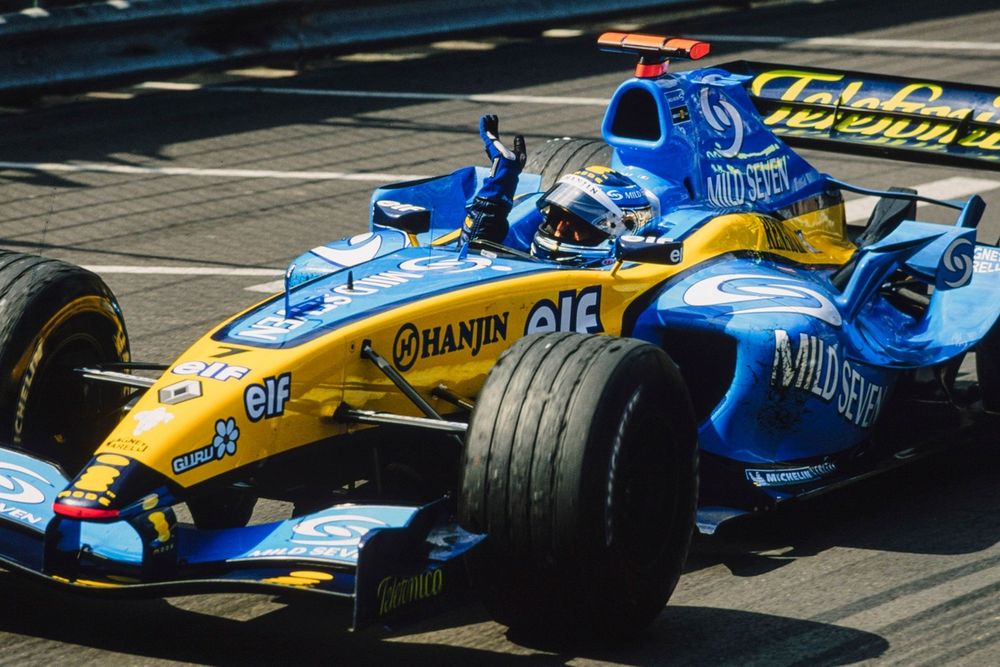
- Alonso Era: Returning as a full constructor, Renault won back-to-back drivers' and constructors' titles in 2005 and 2006 with a young Fernando Alonso, halting Ferrari's reign.
- Crashgate Scandal: The team's reputation was tarnished by the 2008 'Crashgate' scandal, where it deliberately orchestrated a crash to help Fernando Alonso win the Singapore Grand Prix.
- Final Win: Under the Alpine branding, Esteban Ocon scored the Renault-powered team's last victory in a chaotic 2021 Hungarian Grand Prix.
What's next:
- The Alpine team will remain on the grid but will switch to Mercedes power units starting in 2026, ending its identity as a works manufacturer team.
- This move effectively shuts down Renault's F1 engine operations at Viry-Chatillon, marking the end of an era for one of the sport's most storied engine builders.
- The decision reflects the harsh economic realities of F1, where developing a competitive power unit in-house has become prohibitively expensive for all but a few manufacturers.
Original Article :https://www.motorsport.com/f1/news/as-renault-says-farewell-to-f1-21-key-moments...