





Gary Anderson Analyzes Mercedes' Montreal Upgrade Amid Wolff's Uncertainty
Mercedes rolled out its first major upgrade package of the 2026 season in Montreal and swept the weekend, with George Russell winning the sprint and Kimi Antonelli taking the grand prix. Despite the dominant result, team principal Toto Wolff admitted he isn't fully convinced the package delivered the performance step it promised on paper, leaving experts like Gary Anderson to parse what actually changed beneath the bodywork.
Why it matters:
The decision to introduce a significant update during a sprint weekend at a circuit where Mercedes already excelled last year was inherently risky. With the team enjoying early-season dominance, a misstep could have disrupted momentum rather than extended it. Wolff's caution underscores a central reality in modern F1: even when the timing screens look good, isolating the true impact of new parts from favorable track characteristics, variable weather, and the compressed schedule of a sprint format is notoriously difficult. If this upgrade genuinely moves the needle, it could cement Mercedes' championship push; if it's merely track-specific, resources might be chasing the wrong development path.
The details:
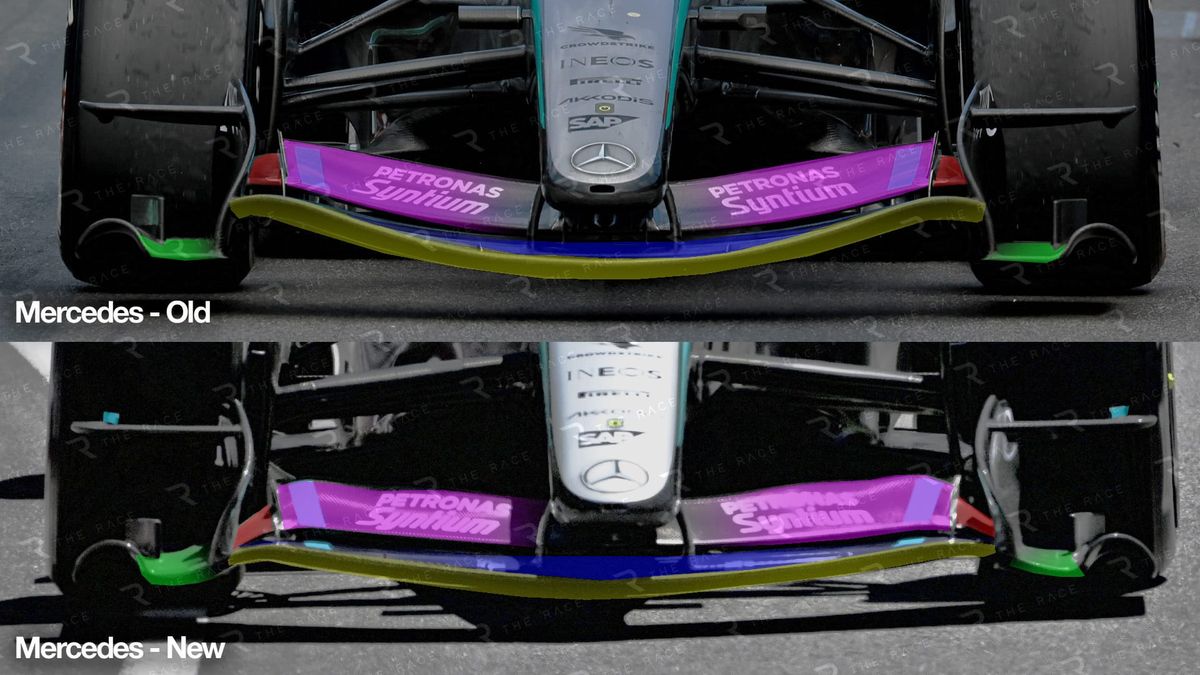
- Front wing overhaul: Mercedes introduced an entirely new front wing assembly. The leading-edge separation point is now integrated with the endplate separation point, similar to Red Bull's season-opening concept. This creates a more unified airflow structure underneath, reducing transverse flow and making the inwash and outwash generated by the front tires easier to manage through varying steering angles.
- Endplate refinements: A revised endplate fin and upper-rear profile accommodate the footplate changes. An additional small fin on the upper surface increases outwash around the front tire, helping push dirty air away from critical downstream aerodynamic surfaces.
- Bargeboard revisions: With altered flow coming off the front tire, the bargeboard area required significant re-optimization. Mercedes repositioned element separators and replaced two-piece first and second elements with stiffer, lighter single-piece components. The chord length appears reduced, and the trailing-edge angle of the first element is less aggressive, working in tandem with a softened floor-edge profile.
- Floor-edge sealing: The rear floor edge was revised dramatically to improve aerodynamic sealing. Inboard airflow, paired with rear tire squirt, is drawn upward by turning vanes on the inner face of the rear brake ducts. This generates downforce directly on the unsprung mass, meaning there is no time delay under braking as the suspension settles. These vanes also reduce diffuser leakage caused by rear tire displacement, while outboard airflow is redirected to allow the inboard flow to work harder.
What's next:
Canada offered a promising first impression, but Wolff and Anderson agree it is not the place for a definitive judgment. Montreal was already a sweet spot for Mercedes last year, and the absence of McLaren's true pace reference over the weekend clouds the picture. The next two rounds in Monaco and Barcelona will serve as the real proving ground. Only on more conventional circuits, away from Montreal's unique demands, will Mercedes learn whether this upgrade is a genuine step forward or simply benefiting from the track's friendly layout.
Original Article :https://www.the-race.com/formula-1/gary-andersons-take-on-the-upgrade-mercedes-s...