





F1's Unsolvable Wet Weather Visibility Problem with Ground Effect Cars
Formula 1 is facing a fundamental, unfixable problem regarding poor visibility in wet weather racing with its current ground effect cars. This reality became starkly clear after the Belgian Grand Prix weekend, which reignited debates about rain racing and the need for solutions.
Why it matters
Delays in starting Sunday's Spa-Francorchamps race drew criticism from fans and some drivers, who felt the FIA waited too long for the track to dry. Max Verstappen was particularly vocal, suggesting it was nonsensical to delay the start so much, even with the FIA's stated conservatism after recent wet crashes.
- "It's a bit of a shame," Verstappen said. "I knew that they would be a bit more cautious after Silverstone, but this also didn't make sense. Then it's better to say: ‘You know what? Let's wait until it's completely dry and then we just start on slicks’. Because this is not really wet weather racing for me."
Not everyone agreed. Given the known dangers of Spa's Raidillon corner, George Russell argued against pushing too soon.
- "As a racer you always want to get going, you love driving in the rain, but the fact is when you're doing over 200 miles an hour out of Eau Rouge and you literally cannot see anything - you may as well have a blindfold on," he commented. "It isn't racing, it's just stupidity. So I think considering it was clearly going to be dry from 4 o'clock onwards I think they made the right call."
Despite paddock surprise at the FIA's caution, there was also acceptance that playing it safe was preferable to rushing and risking a major accident.
The core problem: Ground Effect Cars
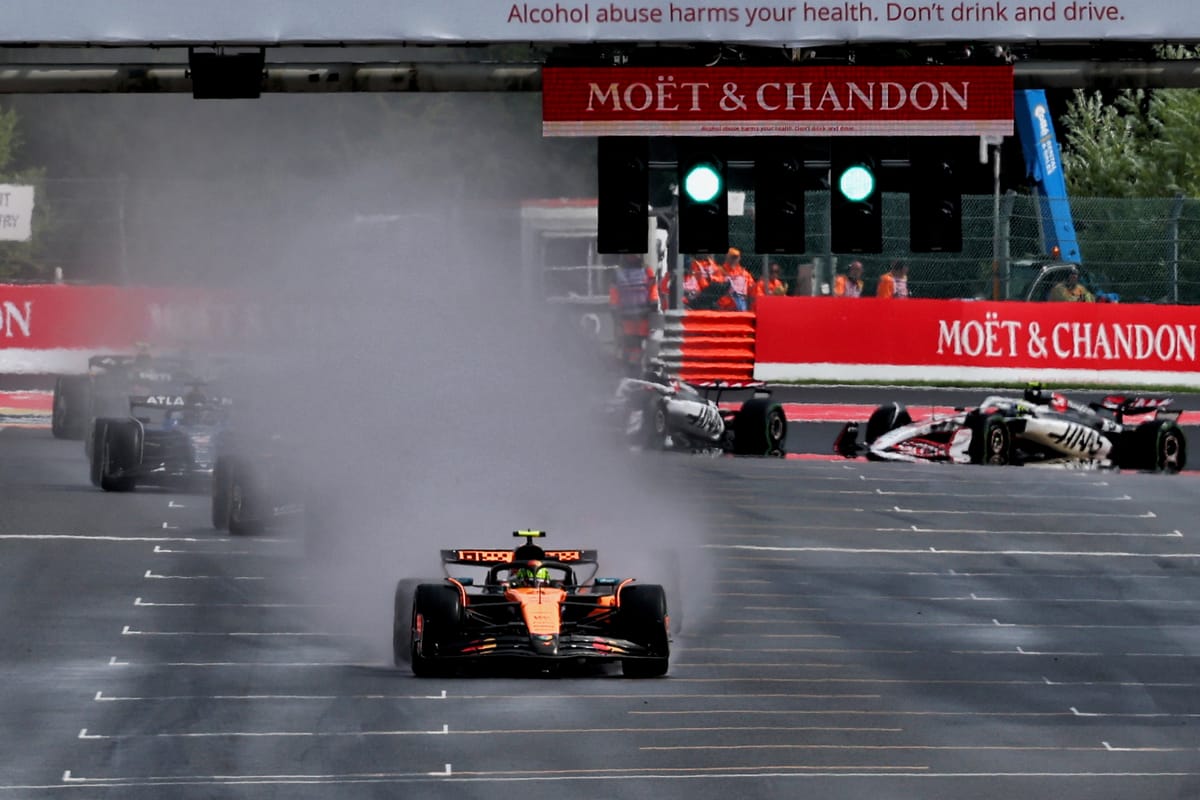
F1's wet weather racing issues are not new, nor is the understanding that the real problem is driver visibility, not a lack of grip. This is not about tire performance. The issue stems from the intense spray generated by the cars themselves, which has worsened over time as downforce has increased.
Ironically, current regulations, designed to minimize dirty air and prevent airflow from spreading widely, concentrate the spray directly behind the cars in wet conditions, making it harder for following drivers to see.
Failed solutions
Attempts to solve the spray problem have so far been unsuccessful. In 2023 and 2024, McLaren, Mercedes, and Ferrari assisted the FIA in testing various wheel rain guards. Minimalist solutions at Silverstone failed. A more extreme version, tested by Ferrari at Fiorano, also yielded no significant improvement in visibility for following drivers.
- The conclusion: most of the spray is actually thrown up from the car's floor and pumped out by the diffuser, not the wheels.
- As Ferrari team principal Fred Vasseur explained: "In the end, the spray is coming from the floor. It means that there is nothing that we can do, or you have to stop massively the performance of the car if you want to put something there."
FIA single-seater director Nikolas Tombazis confirmed that spray guards for tires were abandoned due to their ineffectiveness. The airflow under the car, crucial for downforce in current regulations, is fundamental to the spray issue. Stopping the spray would dramatically impact performance.
- When asked about diffuser covers to contain water, Tombazis stated it would be impossible due to its impact on downforce: "Theoretically you could do something there, but that would be like removing all the downforce and so on. So it would be quite an issue. It's not an easy next step, to be honest."
The outlook
F1's 2026 regulations will feature less powerful Venturi tunnels, which might slightly reduce spray. However, cars will still generate substantial downforce and thus displace significant amounts of water. Without a technical solution to prevent spray, the only way to ensure safe racing is to wait for conditions to improve, regardless of its unpopularity with some.
- Vasseur highlighted the danger: "This [the lack of visibility] I think is the most dangerous because if there is a crash in front of you, you can't see the car who has stopped on track."
- He added: "We can't blame them [race control], because we would be, collectively, the first one to give them s**t if something happened. So in this sense, we have to respect their decision. I'm not sure that on this car we can do something different for the spray."
Ultimately, race control's cautious approach is a necessity, as those criticizing delays would be the first to condemn an accident caused by poor visibility.
Original Article :https://www.the-race.com/formula-1/why-f1-cant-solve-its-wet-weather-problem/
