





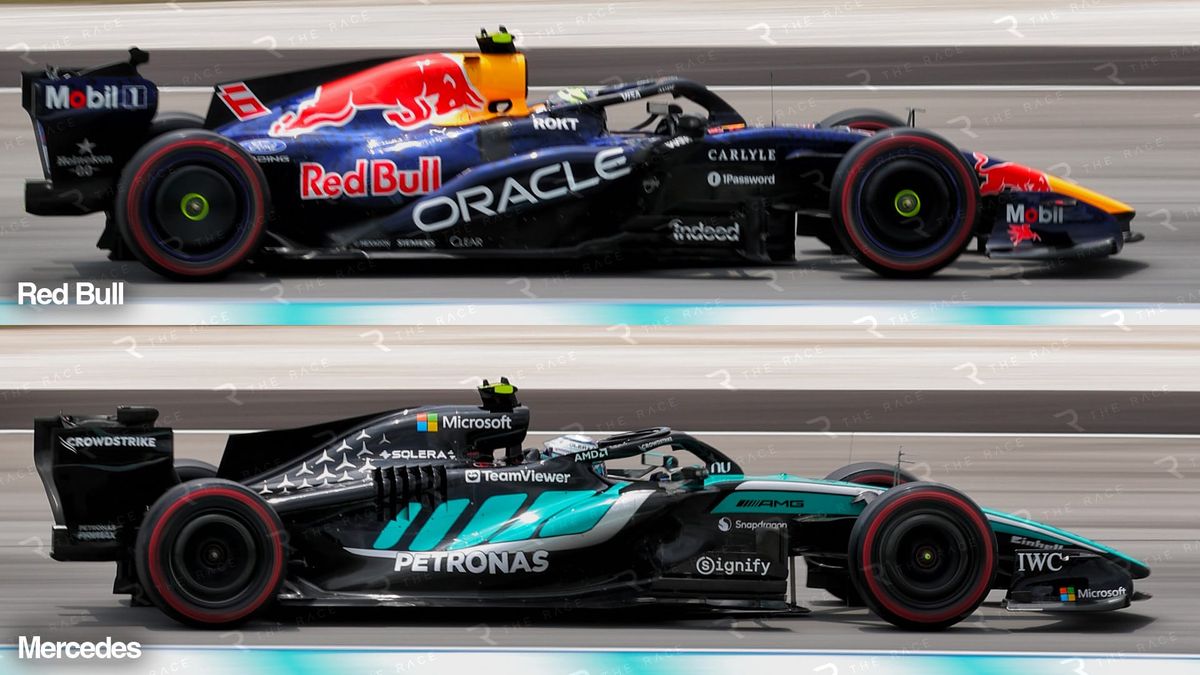
Technical Breakdown: How Red Bull's Marginal Gains Outpaced Mercedes
Red Bull has officially overtaken Mercedes as the dominant force in Formula 1, a shift highlighted by their recent string of victories. While the two cars appear visually similar under the prescriptive 2026 regulations, the performance gap lies in the execution of marginal gains rather than a singular breakthrough.
Why it matters:
In an era of draconian technical rules, the margin for improvement has shrunk from tenths of a second to hundredths. Mercedes' recent struggle demonstrates that development packages can be a double-edged sword; while their data may show positive gains, the cars have become harder to drive, proving that theoretical speed is useless without driver confidence and consistency.
The Details:
- Front Wing Philosophy: Mercedes opted for a weight-saving concept with the front wing mounted on the second element, which acts more as a flow-direction optimizer. In contrast, Red Bull utilizes a longer-chord mainplane and sophisticated endplates, reducing sensitivity during braking and cornering.
- Wake Management: Red Bull has implemented a more aggressive approach to tidying front-tyre turbulence. By managing the "wake" more effectively through the bargeboard and floor plate area, they ensure cleaner airflow reaches the underfloor.
- Sidepod Innovation: Red Bull employs a "gully" design with a sharp trailing edge. This creates a concentrated vortex that travels along the rear brake ducts, significantly boosting the performance of the diffuser's central section.
- Floor Sealing: To combat "tyre squirt"—the air pushed out by the rotating rear tyre—Red Bull uses a precise vent system. This acts as a sealing mechanism, preventing high-energy air from leaking under the car and disrupting low pressure.
The Big Picture:
This technical battle underscores that the current regulations haven't killed innovation; they've simply moved it into the "grey areas." From the controversial exhaust exit ramps used to redirect flow upwards for rear downforce to the precise radii of sidepod corners, the championship is being decided by those who can best exploit the gaps in the rulebook.
What's next:
As the season progresses toward the final rounds of 2026, the focus shifts to whether Mercedes can stabilize their development path. Red Bull's ability to turn a disastrous start into a dominant run suggests a superior understanding of the current aero-map, leaving Mercedes to scramble for a solution that balances raw speed with driveability.
Original Article :https://www.the-race.com/formula-1/details-that-really-separate-red-bull-and-mer...