
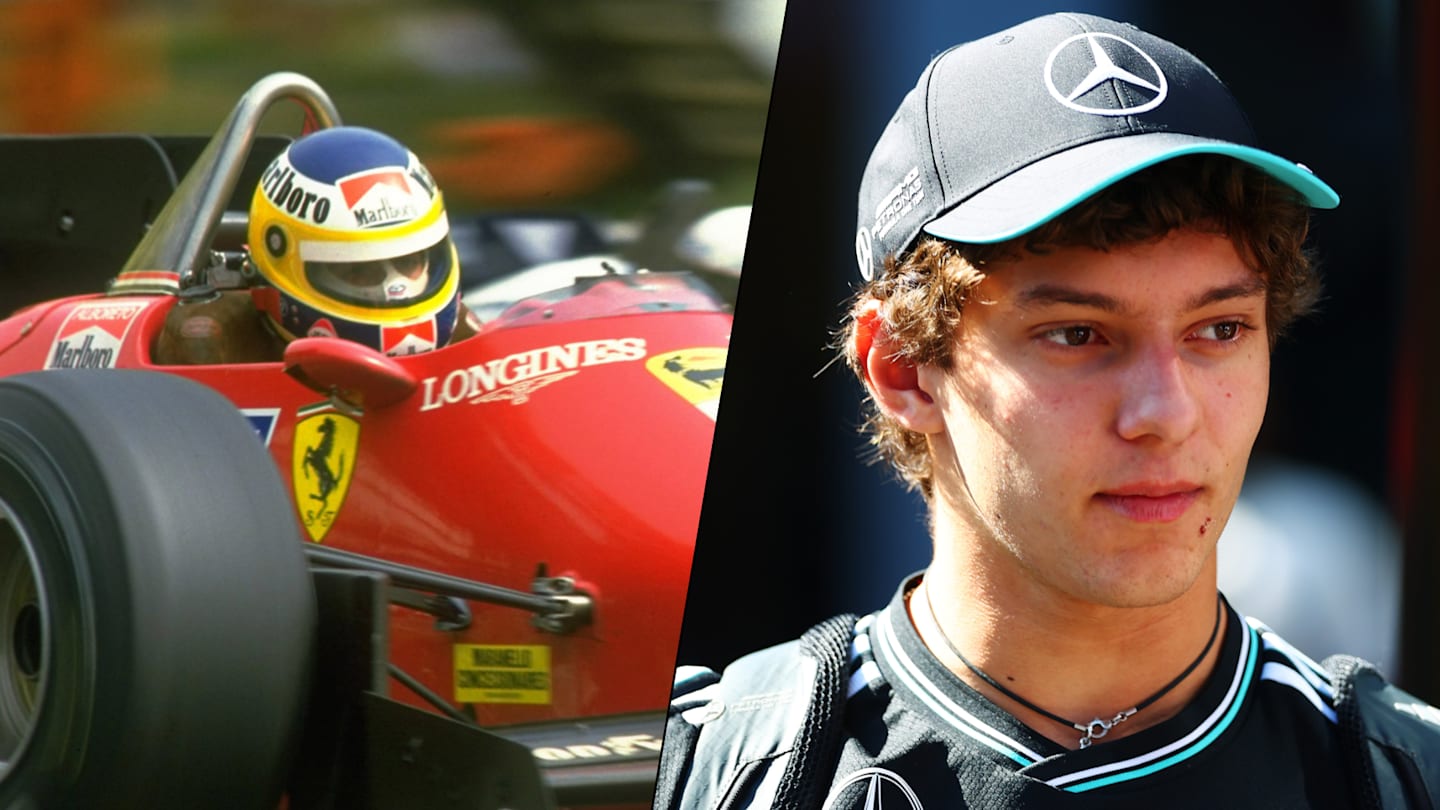
TREMAYNE: Antonelli is giving Italy reason to dream again, exactly 40 years after the last Italian to challenge for the championship
TREMAYNE: Antonelli is giving Italy reason to dream again, exactly 40 years after the last Italian to challenge for the championship
Alain Prost. Ayrton Senna. Lewis Hamilton. Max Verstappen. When each arrived in Formula 1, it wasn’t difficult to predict world championships in their futures.
I feel the same way when I watch Kimi Antonelli.
There is something such racers all show from the moment they step into the arena. Not just raw speed, of course – because most F1 racers have that in spades – but that inner confidence in themselves and the way they handle the cars and the pressure, plus that Alonso-like extra capacity beyond what is required to achieve fast laps, that lets them take in the whole picture.
Kimi has made a huge impression already. Forget his somewhat Gilles Villeneuve-esque debut at an official race weekend, when his FP1 session for Mercedes lasted just a few laps before he parked George Russell’s W15 in the wall at Monza’s Parabolica last September. That was an understandable error of over-enthusiasm. You can always slow a quick guy down, but can never make a slow guy quick…
This year he has been fast and contained. And, following our recent story about Italian champions, it made me think of the last man on whom the Italian nation was relying to deliver a title.
In pre-war years the great Tazio Nuvolari and Achille Varzi upheld national honour brilliantly. Then came Giuseppe Farina and Alberto Ascari, the first official champion in 1950, and his double-crown successor in 1952 and ’53. But it was then a very long wait until Michele Alboreto ran in genuine contention for the title in 1985, with Ferrari.
I always liked Michele. As Kenny Acheson will tell you after their F2 clash at Pau in 1981 left him with broken legs, he could be a hard old boy on track, but that went with the territory.
Out of the cockpit he was polite and good-natured, and I remember interviewing him when he had returned to Tyrrell for 1989. Things were a little bit formal initially, but when we got on to the subject of children, he lit up. I loved his sheer passion for racing, his friendship with his idol Ronnie Peterson, and how he had his helmet painted in its yellow and blue colours in Ronnie’s honour.
Racers such as Keke Rosberg, Riccardo Patrese and Gerhard Berger loved him. And so, tellingly, did Enzo Ferrari. Some observers suggested that he later lost some of his edge after the birth of his two daughters, but I disagree. Friends always said of him that he had gasoline in his veins. And he adored the act of race driving.
I remember him looking very strong in that Tyrrell until a mid-season clash between his Marlboro backing and Ken Tyrrell’s acquisition of Camel support unfortunately saw him lose the ride to Jean Alesi.
That was a pity, because Uncle Ken had given him his F1 break in 1981, after he’d won the European F3 championship in 1980. By 1982 he had found his feet, and when others ran into trouble in the second Grand Prix run in Las Vegas, he emerged victorious in the Tyrrell 011. Nine months later he did it again when a punctured left rear tyre hamstrung Nelson Piquet’s Brabham-BMW and left the door open for Michele to take a second victory, in Detroit.
It also opened the door for Enzo Ferrari to come calling. Il Drake was never keen to employ Italian drivers after the outcry following the deaths of Eugenio Castellotti and Luigi Musso in his cars in the 1950s, and Lorenzo Bandini in the 60s, but there was something irresistible about the chirpy 27-year-old from Milan.
Out of the car he was generally placid, often humble, but in it he could get the job done.
The 1984 season proved tough with the 12C4, but he won the Belgian GP in textbook style from pole position, leading every lap. Seconds in Italy and Germany and a third in Austria confirmed his own ability.
The 1985 156-85 was initially a better car that finally gave him his title shot. He started from pole in Brazil and finished second to Alain Prost. He repeated that result in Portugal, and thus found himself leading the points table.
Electrical failure dropped him to second behind winner Elio de Angelis after Imola. He stayed there despite the drive of his life in Monaco. Starting third, he fought back after a spin and a puncture to finish second behind Alain on a day when he’d had the world champion-elect beaten.
He got his reward with victory next time out in Canada, which put him back on top of the points table. Third in Detroit; second in Britain; another victory, in Germany; and third in Austria kept him there, albeit now equal with Prost on 50 apiece.
But behind the scenes there had been a key turning point. Enzo Ferrari had become dissatisfied with the supply of components he was receiving from KKK, the German turbocharger manufacturer. He incorrectly believed that McLaren were receiving preferential treatment and imperiously ordered his men to use American Garrett turbos instead.
After dropping to second after a fourth place in Holland, Michele’s season fell apart thereafter with a series of mechanical failures and inconclusive fiddling with aerodynamics. Incredibly nobody else beat his points tally so he finished runner-up to Prost, but the great chance was over.
Many felt that Ferrari had been the architect of his disappointment, denying him a title he would richly have deserved. And years later, Ferrari himself acknowledged that when he told his confidante Franco Gozzi more than once: “We owe a world championship to that kid!”
I don’t see that emotional negativity befalling Kimi with Mercedes, especially as there is already such a strong personal bond between him and Toto Wolff. If you like, Toto is playing the Ron Dennis mentorship role and Kimi Lewis’s role as the protégé.
Thus far, with the first quarter of the 2025 season completed, the rookie has impressed. His qualifying times have got steadily closer to George’s (and he out-qualified his team leader in Miami), and we know how quick the Briton is. There is still some work to do on outright race pace, but that will come.
“I think the high point definitely was seeing his speed on a single lap, great,” Toto said recently after that Sprint pole lap in Miami, which made the 18 year-old from Bologna the youngest-ever F1 polesitter. "He showed his talent this weekend but had a race where he will take away some good learnings. That is completely normal for a rookie driver. The race management will come as he continues to build his experience.”
Mercedes’ trackside engineering director Andrew Shovlin echoed those sentiments. “Whilst George benefited from the Virtual Safety Car, Kimi lost out having stopped just before it came out... Some traffic in the pit lane cost him and ultimately his pace on the hard tyre consigned him to P6. It has still been another good weekend for Kimi though, as he continues his development.”
Like Michele, as a child Kimi used to lie on the floor at home playing with his model racing cars, and he exudes exactly the same raw passion for very fast driving.
For me, Suzuka was the real developmental point of his career thus far. He admitted that he was lost, lacking confidence on the very quick track, all through Friday. At the end of the day George had lapped almost 1.2 seconds quicker than Antonelli. Some helpful words from Valtteri Bottas worked wonders on Saturday, when the Italian got that gap down to just two-tenths to qualify sixth, one place behind Russell. And his drive on Sunday was exemplary as he finished only 1.309s behind George.
That pole in Miami, whether helped or not by the weather and the timing of his runs, and then third quickest time in Qualifying for the Grand Prix itself, further underlined how much progress he’s already made in such a short time. I think Michele would be proud of him.
Original Article :https://www.formula1.com/en/latest/article/tremayne-antonelli-is-giving-italy-re...